What a murder mystery let me say about prayer
Simon Woodman explains the thinking behind his first ever novel
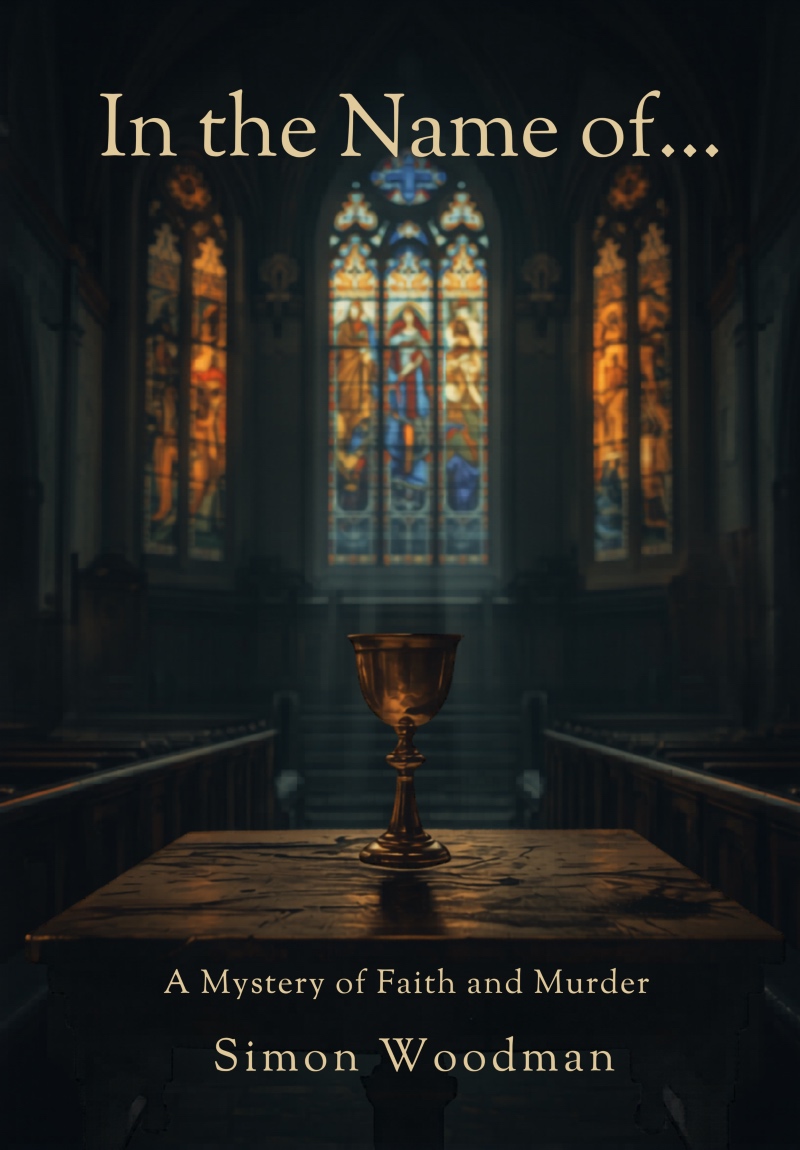 I spent part of my recent sabbatical writing a novel, in which a Baptist minister walks into her own church early one morning and finds a dead body laid out on the communion table, with the chalice tipped on its side and a verse from the Book of Revelation pinned to the sleeve of the corpse.
I should say at once that this is not the sort of thing that happens at my own church, Bloomsbury Central Baptist Church. As far as I'm aware.
The minister is the Revd Susan Carmichael, and her church is on Shaftesbury Avenue in the heart of London’s West End. She is a scholar of the Book of Revelation, which turns out to be an inconvenient specialism when someone starts working through the seven bowls of God's wrath from chapter sixteen and enacting them, one at a time, as a series of killings across London. She knows the text better than she'd like, and she also, before very long, begins to suspect she knows who is enacting God’s judgment on her doorstep.
People have asked me, sometimes with a slightly worried expression, why a minister would want to write about murder. The honest answer is that I didn't set out to write about murder. I set out to write about prayer, and the murders arrived to give me somewhere to put it.
Here is what I mean. A sermon, for all its gifts, is under a certain pressure to arrive somewhere. We have 20 minutes, give or take, and a congregation who have come out on a wet Sunday, and by the final hymn we are more or less obliged to have landed.
We resolve things. It is part of the job, and I don't complain about it.
But some of the truest things I know about faith do not resolve, and I have spent a good deal of my ministry trying to find honest ways to say so. A novel, I discovered, will let you stay in the unresolved place for several chapters and call it a virtue.
This is my first novel, and having previously written only non-fiction, the difference took me by surprise. I could have written a book about prayer, or about the misuse of Scripture, and there would have been room in it to argue the case at length and with all the proper qualifications.
But an argument, however good, invites the reader to agree or disagree from a safe distance. A story does something else. It puts you inside a woman kneeling on a hospital corridor with the whole of her will bent at God, and then it makes you sit with her when nothing comes. You do not conclude that unanswered prayer is difficult; you feel it happen to someone you have come to care about.
Fiction cannot prove anything, which is precisely its freedom. It is not obliged to win the argument, only to tell the truth about how something feels from the inside, and on a subject like this that turned out to be the truer instrument.
For the unresolved place I most wanted to sit in was prayer. Specifically, the kind of prayer that doesn't work.
Susan carries a grief. Years before the book begins, she prayed for someone she loved with everything she had, with the whole of her will bent at God like a fist, and he died anyway. She has never entirely recovered her nerve. But then, in the middle of the horror of the killings, small graces start arriving that she did not ask for and cannot account for. A cab appears from nowhere when she has stopped hoping. A thing she needs turns up by accident. The prayers she flings with all her strength go nowhere. The ones she barely dares to whisper, half-ironic, expecting nothing, seem somehow to be answered.
She spends much of the book trying to work out the rule. If demanding prayer fails and idle prayer is answered, then perhaps the trick is simply to want less, to ask more casually, to game the mechanism. And then she stops herself, because she can see where that leads. It would mean that the man she loved died because she wanted it too much. No God worth the name works like that.
That, in the end, is the thing the novel is really about. Not a formula for prayer that works, but the refusal to turn prayer into a formula at all. The temptation, when we are frightened, is to make faith into a machine with handles we can pull. Pray hard enough, believe correctly enough, and the outcome is secured. But a God who can be operated is not God; it’s a vending machine with a beard.
The harder and more faithful path is to keep praying into the dark without knowing what the prayer is doing, or whether it is doing anything, and to let the not-knowing be part of the faith rather than its failure. This is Holy Saturday territory, the long silence between the cross and whatever the cross turns out to mean, and I think we live there more than we admit.
The other thing the novel let me explore, and here the murders earn their keep, is what happens when Scripture is misused. My killer is not a stupid man. He is a serious reader of the book of Revelation, and everything he does he does from the text. He has simply read it as a warrant for wrath, a manual for the punishment of the wicked, God's violence with his own hand on the trigger.
Against him, Susan reads the same book and finds something else entirely: a God who stands with the victims of empire rather than raining down the bowls on them, a Lamb who is slain rather than slaying.
The whole novel, underneath the plot, is an argument between those two readings. It felt worth having as an argument, because the misuse of the Bible to license cruelty is not a fictional problem. We have all seen it done.
I don't want to overclaim for a book that is, first and last, a murder mystery, and one I hope is properly gripping. It has bodies in it, and a detective, and a plot that I have done my best to make turn the pages. But writing it taught me something I will bring back into the pulpit as I return from Sabbatical, which is that the questions we cannot answer are not the enemies of faith. They are quite often where faith actually lives.
Susan would tell you she still doesn't know whether her prayers were heard, but she has decided to keep praying them anyway. On my better days, so have I.
The Revd Dr Simon Woodman is minister of Bloomsbury Central Baptist Church, and has a doctorate on the Book of Revelation.
His first novel In the Name of… A Mystery of Faith and Murder is available in paperback and ebook from Amazon.
05/08/2026