Holy Ground: a chaplain’s reflection on grace and weakness
By Dave Etherington, an accredited Baptist minister serving as a healthcare chaplain for South Tyneside and Sunderland NHS Foundation Trust
I knew the patient from a previous hospital admission. He was in his late 40s, facing a terminal cancer diagnosis, and had been told he had only a couple of months left to live. The medical prognosis suggested a difficult, physically painful path ahead. He was frightened to die.
Compounding his physical suffering was a deep spiritual anxiety. From a religious perspective, he felt he ought to be coping with far greater strength and acceptance. He was also suffering from a severe, relentless skin rash that kept him awake at night, adding an agonizing layer of exhaustion to his final days.
When I entered his hospital bay, the physical toll of the illness was clear. He had lost significant weight, and his bare chest was covered in a red, blotchy breakout. He was scratching it gently, almost unconsciously.
I shook his hand, but felt an immediate flash of apprehension. Only a few months prior, I had suffered from a severe skin condition that lasted for 16 weeks. Knowing I needed to wash my hands immediately, and fearing this might look insensitive, I chose instead to use the moment to share a fragment of my own experience. It was an instinctive decision that instantly strengthened our rapport, creating a bridge that we would later use to talk about the grace of God.
He began to tell me about the Footprints in the Sand poem, and then shared a vivid dream he had experienced a few months earlier. He paused, looking at me, and said, 'It’s helpful to remember this dream, especially after being told I’ve only got two months left to live.'
In the dream, he was healthy and back at his former job, working with children with learning disabilities. As a child, he had been bullied, but he had always felt a special, joyful connection with these children. I could still sense that joyful disposition within him. Even now, with terminal illness weighing heavily upon his weakened, pale frame, that joy would occasionally break through, shining out from his watery eyes and escaping in a smile across his cracked lips.
In the dream, he was escorting the children, feeling truly alive. He saw a door open before him, stepped through, and found himself in the presence of a figure he sensed was Jesus, though the face was not visible. The figure placed an arm on his shoulder and said, 'Well done, good and faithful servant.'
In the dream, the patient replied, 'But you know I’ve got cancer, right?'
Jesus responded, 'We’ll talk about that later.'
The patient told me he felt an intense sense of acceptance in God’s presence within that dream—an acceptance he completely failed to experience during his waking hours. As a Christian, he simply did not believe it was acceptable to be afraid to die, to have doubts, or to struggle.
'I've felt really distant from my faith,' he admitted. 'Not that I’ve abandoned it or been abandoned by it, but at the same time, I do feel I have abandoned it, and I have been abandoned.'
I asked if I could share a little more of my own skin crisis, hoping it might help. He quickly agreed.
I described how a severe case of contact dermatitis had broken me physically, mentally, and spiritually. I told him how I had stopped praying, stopped reading the Bible, and stopped going to church. I was unable to function or sleep, entirely consumed by the discomfort.
'In the middle of the worst night of that 16-week experience,' I told him, 'when I couldn’t sleep and was pacing the floor in despair, I shouted from the depths for God to help me. And something happened. I got a clear sense that God was saying: ‘It’s ok to not be ok. I don’t expect you to be a perfect patient. What makes you think my love for you is dependent upon how well you perform?’ Then I heard the words of St Paul: ‘My grace is sufficient for you, for my power is made perfect in weakness.’'
He received those words like a child receiving a gift on Christmas morning.
'This place is holy ground,' I said to him. 'In the hospital and the hospice, I feel like I should take off my shoes, just as Moses did by the burning bush. God is here.'
I offered a thoughts on his dream: 'I wonder if Jesus was faceless because He is present in the faces of those we meet in life—especially those who love and bless. You are an image of Christ to me in your difficulty and suffering.'
We spent time reflecting on how Christ’s own body was broken. Before He ever reached the cross, Jesus was frightened to die in the garden, and on the cross, He felt abandoned too. If He could experience that abandonment, surely it is permissible for us to feel that way. God does not judge us for our weakness.
I asked him if he would like to share in Holy Communion. He was delighted.
We read from 1 Corinthians 11, and then we prayed. I gave thanks for the hope that exists in the Christian faith—that Christ’s pain and crucifixion are pointers to the renewal that follows, where love will reign, all will be well, and love will have the final word.
Then, to my surprise, the patient began to pray. His words were raw, honest, and vulnerable. A new dawn of acceptance surfaced. Afterward, he looked at me and said, 'I feel like I have more acceptance now. Christ is above me. He is below me. Within and without. He is on my left and on my right.'
Amen.
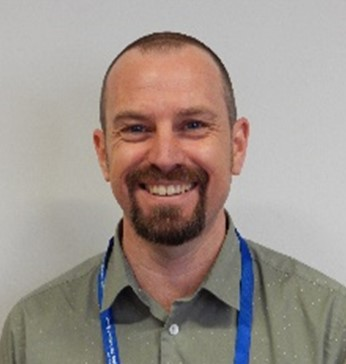 Dave Etherington is an accredited Baptist minister serving as a healthcare chaplain for South Tyneside and Sunderland NHS Foundation Trust.
He is passionate about pastoral care, companioning individuals through terminal illness, and exploring the intersections of physical vulnerability and spiritual grace.
Image | Naseem Buras | Unsplash
21/09/2026