Prince and Professor debate love
The largest bookshop in Europe was the venue for a debate on love in Islam and Christianity on Monday evening this week (27 March). At Waterstones in Piccadilly, among eight miles of bookshelves, HRH Prince Ghazi bin Muhammad of Jordan joined Professor Paul Fiddes, well-known Baptist theologian, to present a project in which they are both participants
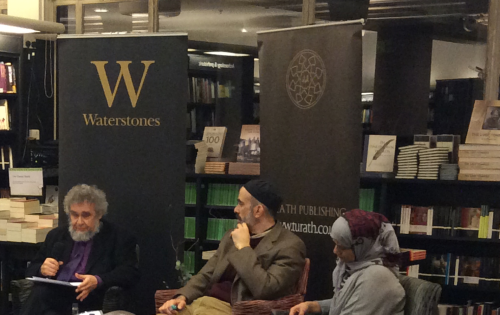 This is the inter-faith project for The Study of Love in Religion, centred at Regent’s Park College in Oxford, and funded over the past year by the John Templeton Foundation.
The occasion was prompted by the launching of Prince Ghazi’s newest book, A Thinking Person’s Guide to Islam, and it gave the opportunity to reflect on the nature of divine and human love.
The audience gathered in the bookshop was swelled by hundreds watching the debate on Facebook, and by numerous members of the United Church of Christ in the USA over whose ‘Global Ministries’ network the event was relayed live.
Prince Ghazi gave the opening presentation, in which he began by condemning the recent ‘act of madness’ at the British Parliament building in which a policeman and passers-by had been killed by a terrorist claiming to be Islamic. He made the point that this only accentuated the need for believers in every religion to understand the central place of love in their faith.
He then developed vividly the stages by which people fall in love with each other, illustrating the process from a range of novels and poems. Love as desire for beauty, he affirmed, is finally fulfilled in love of God who is the supremely beautiful One.
With close reference to the Qur’an, Prince Ghazi distinguished between the kind of love in which the lover opens himself or herself generously to another, and the kind of love in which people turn in on themselves in wanting only to possess the other. True love of the first kind, he affirmed, is described by Jesus Christ, as recorded in the Gospels, as love of God – with all one’s heart, mind, soul and strength – and love of neighbour as oneself. The Qur’an, he affirmed, bears witness to this double command to love.
Provocatively, he ended by suggesting that the stages of love through which the soul passes can be seen as totally consistent with a scientific understanding of natural laws, a thesis he had advanced at an international conference of the ‘Love in Religion’ Project at Oxford last November.
 Professor Fiddes began by describing a recent event staged by the Love in Religion Project, a liturgy in which extracts from Shakespeare’s love-comedy A Midsummer Night’s Dream had been placed in the context of a Christian act of worship which used words about love from the Christian tradition. The liturgy had been first presented in Stratford-Upon-Avon on the occasion of the World Shakespeare Congress last August.
Professor Fiddes quoted from members of the congregation, who had been startled and yet convinced and moved by the merging of poetry about passionate and romantic love with affirmations of the love of God and neighbour. This led him into the theme of human love as an image of divine love, human passion as a window onto divine compassion.
Taking up Prince Ghazi’s understanding of love as desire for beauty, Professor Fiddes argued that true love is always a blend of eros — or desire for another which fulfills the self — and what Christians have called agape-love, or sacrifical self-giving to the other. This, he said, was the nature of both divine and human love, which both involve suffering.
Human beings are to love with the love of God, he urged, and yet God also wants human beings to be responsible In loving in their own way, and this satisfies God’s own love for the world. Like Prince Ghazi, he drew attention to Jesus’ call to this responsibility in the double love-command (taken from the Jewish Torah). Love of God and neighbour was in fact at the centre of the recent Open Letter from Muslim Scholars to Christian Leaders called A Common Word, and the project at Oxford was an extension of this venture.
Professor Fiddes concluded by affirming that for Christians love was summed up in the symbol of the Triune God, which was not a mathematical puzzle but a network of relations of love in which God calls created beings to participate.
Questions from the audience followed these presentations, including one which asked how the Oxford project on love would reach people ‘on the ground’. The answer given was that it was designed to take good, academic thinking about love beyond the walls of the University into local religious communities, and also into wider society, by creative means such as the ‘Shakespeare liturgy’. Part of the vision was also to influence students who came to to Oxford from all parts of the world, and who would be leaders and opinion-formers in their own societies in the future.
Baptist Times, 29/03/2017