Baptist Union Council: March 2026
The latest phase of the Financial Model Review was shared at Baptist Union Council, with members voting to approve a new funding approach for 2027-8, and further investigation of options beyond.
Council also received a presentation on developments in AI and reflected on different scenarios relating to AI's role in Christian settings.
This took place alongside the welcoming of new member churches, voting on Key Roles nominations, and WebNet withdrawing its proposal that the Baptist Union of Great Britain adopts the Baptist World Alliance (BWA) Statement of Faith to to sit alongside our Declaration of Principle.
It was the first Council to be moderated by Rob May, and was held at the Yarnfield Conference Centre in Staffordshire from 18-19 March.
Scroll down for the following reports:
-
Worship and prayer
-
Financial Model Review
-
Finance and pensions update
-
Statement from WebNet re withdrawal of request to adopt BWA statement of faith alongside Declaration of Principle
-
AI: implications, guidance and resources
-
New member churches, closures, amalgamations
-
Key Roles Nominations Team
Worship and prayer
Worship was led by Shayla Waugh, a Baptist minister and Baptist Union Trustee. ‘This is an opportunity to seek God together,’ she said at the outset. ‘Let’s make the most of our opportunity.’
Opening with sections from Psalm 27, she invited Council members to reflect on the burdens are we carrying that hold us back from trust or hope. ‘Let’s ask God, so we can freely participate and discern.’ She highlighted verse 4. ‘Do we come this morning in single hearted devotion to God?’
Communion was shared on Wednesday. During this time Shayla invited members to write a line of a Psalm. She weaved the contributions together, which Council spoke as the gathering closed on Thursday.
Financial Model Review
 Council members overwhelmingly approved a recommendation to move to a ‘simpler, fairer, proportional’ funding approach for Baptists Together for 2027-2028 – while continuing to explore options post 2028.
The decisions were the latest phase of the Financial Model Review (FMR), which is seeking to make Baptists Together financially sustainable in the future to best support local mission and ministry.
They were taken after much of Wednesday was devoted to the FMR, with various members of the Financial Sustainability Working Group (FSWG) sharing updates on progress so far.
The FSWG was created following the specially convened, FMR-focused June 2024 Council to develop detailed proposals for sustainability.
Three options have been explored and in their briefing paper Council members were presented with strengths and weaknesses of each.
The first option involved replacing the current funding formula, with a more ‘transparent’ one, involving a baseline for core costs such as staffing per 100 churches per Association, and a baseline for Strategic Mission Resourcing. This formula would fund essential roles and basic running costs consistently across the country, but not dictate how Associations spend their allocation. It contrasts with the current formula, which is now seen as ‘outdated, overly complex, and poorly understood, making communication with churches difficult, hindering financial stability,’ the briefing paper stated.
A number of weaknesses were highlighted, namely that it does not reduce structural complexity; the church-numbers basis may overlook pioneering/missional communities; and it ‘does not directly solve the fundamental issue of needing more income.’
Nevertheless, this option was recommended to Council by FSWG, having been backed by Associations during an FMR meeting in February.
It is ‘the most workable and least disruptive’ change right now, ‘making for more predictable financial planning, and provides a clearer basis for explaining costs to churches,’ the briefing paper continued.
The briefing paper outlined two further options which had been explored by the FSWG, but both shared a key drawback, namely the increased costs of the Family Solution Loan (FSL). The Family Solution was created collaboratively to address the concerns of The Pensions Regulator with regards to the Defined Benefit Pension Scheme in 2018. Part of the Family Solution is an intercompany loan between Baptist Union Corporation (BUC) and BUGB, with the Retired Baptist Ministers Housing Organisation’s (RBMHO) property portfolio providing security. The key benefits were bringing the problem in-house, removing the liability risk, and protecting churches.
However, rising interest rates since 2021 have removed the cost neutrality of the loan, creating a growing, now unsustainable annual loss for BUGB. Furthermore, the anticipated mechanism for paying off the loan – the sale of surplus RBMHO properties – has not materialised, due to demand for RBMHO housing not diminishing as previously anticipated. Additionally changes in regulations for landlords have increased RBMHO's annual maintenance spend, further compromising repayment options.
From January 2026 the cost of the FSL is being covered by BUC surplus. It was explained to Council that the FSL’s financial burden needs to be addressed and stabilised before other options are considered. Writing the loan off is not possible, because the BUC holds deposits from churches which are used to fund the BUC’s loans, including the FSL.
Option 2 involved changing the money flow – giving would go directly from churches to Associations. A percentage would then be passed from Associations to BUGB, while another percentage from some Associations would go into a redistribution pot.
‘While this idea initially appeared simple and attractive, the analysis shows it has become significantly more complex and riskier than originally understood,’ stated the briefing paper.
The core issues with this option are the FSL, and a far more complex redistribution mechanism involving multiple, small income streams. It also doesn’t not resolve ‘core systemwide problems: high costs, low income, declining reserves, and at-risk Associations.’
The third – and most radical – option would be for BUGB and the 13 Associations to close as individual legal entities, and come together as one single legal entity. The Associations would continue as Associations of churches.
The purpose would be to ‘dramatically simplify structures, reduce administrative burden, and enable greater focus on mission, church planting, leadership development, and deliver a shared vision’.
However, while this option has several strengths, it was explained to Council that it too was highly dependent on resolving the FSL and therefore ‘not safe to pursue now’. This option would also require the most emotional energy, a large one-off investment of time and cost, and risks a loss of regional identity and sense of belonging at grassroots level.
‘Option 1 should be adopted first while risks are assessed during 2026,2027 and 2028, and an alternative solution to the Family Solution Loan is developed,’ the briefing paper stated. ‘Option 1 offers a realistic, simpler, and fairer way forward without structural overhaul. It may require some difficult decisions but enables the Union to move ahead with developing and delivering a more fully shared vision and strategy. It emphasises unity of purpose while allowing space for regional difference and to address deeper issues.’
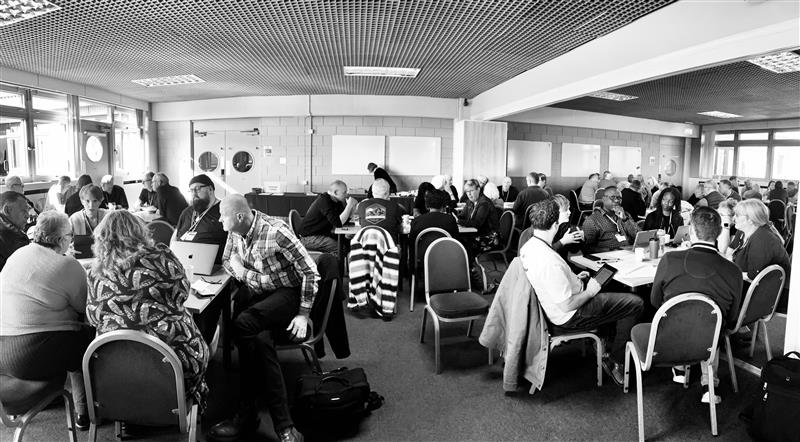
At various points Council members were invited to offer discernment. Table discussion focused on the following questions:
What factors should the FSWG consider when developing a post 2028 solution?
What are the opportunities and risks inherent in adopting Option 1 for 2027 and 2028?
What are the key pieces of work that need to take place alongside Option1, to facilitate continued growth for the Baptist family during 2027 and 2028?
Key points from the table discussions were fed back to the room. There was also space for questions in plenary. Concern was expressed about ‘complacency’, thinking that the situation is solved. ‘The opportunity of Option 1 is that it buys us time to make a braver decision,’ noted one table. ‘The risk is we don’t.’
There was concern too about whether a consensus could ultimately be reached among Associations. In response Associations were keen to express their commitment to finding a way forward, and how good relationships and unity are being developed.
Prior to the vote, General Secretary Lynn Green shared a brief reflection. The aim of the FMR, she reiterated, was to reach a balanced, sustainable budget to fan into flame all that God is doing among us. We know we have to change and are in a time of transition. However, referring to Isaiah 43, she said, ‘It’s not so much that we’ve not found consensus yet – it’s that there is something more to be seen. We have not yet perceived it – there must be more to see.’
Council members were asked to vote on three questions:
-
Option 1 be adopted for 2027 and 2028
-
FSWG continue their work on Byelaw Point 7*, in liaison with BUGB Trustees and Associations
-
FSWG continue to work on what might be put in place after 2028
All were approved overwhelmingly.
*Byelaw Point 7 relates to whether Associations can pursue other fundraising appeals beyond raising funds for Home Mission.
Finance and pensions
 Treasurer Mohan Pandian presented a finance and pensions update prior to the FMR sessions. Home Mission giving for 2025 showed an encouraging increase, up £103,000 to £3,335,000. This is the first time in eight years there has been a year on year gain. Mohan expressed thanks to Associations, and suggested the 'Plus 1% initiative' - which some Associations have adopted to encourage churches to give an extra 1% of their budget to Home Mission - had had an impact.
Despite this increase, Mohan noted that had giving kept pace with inflation in the past decade, Home Mission should now be around £5.5m per annum.
The Home Mission increase resulted, in part, in a lower than expected deficit: a budget shortfall of £800,000 had been anticipated for 2025, but the deficit actually came in at £277k. A good return on investments, tighter expenditure, and nearly £300k in legacies (when we budget zero for legacies) also contributed to narrowing the gap. A deficit of £733k is forecast in the 2026 budget.
Mohan also mentioned the impact of the Family Solution Loan (see the above Financial Model Review section). BUC directors have reduced the rate of the loan, and we are looking to chip away at the capital.
Mohan told members this financial situation set the context for the FMR discussions that would follow. 'This is our family working together for God's kingdom,' he said, 'There's so much more we could potentially be doing.’
The Defined Contribution Baptist Pension Scheme is currently being reviewed, Mohan added. This is because the current structure around the scheme is ‘cumbersome - it takes a lot to run.’ Questionnaires regarding the Scheme are in the process of being sent to Employers, Ministers, and Staff.
Statement from WebNet re: withdrawal of request to adopt BWA statement of faith
Andy Caldwell, WebNet regional minister team leader, made a heartfelt statement to Council explaining why the Association had withdrawn its proposal that the Baptist World Alliance (BWA) Statement of Faith sit alongside the Declaration of Principle (DoP). The proposal had come before the previous Council in October, when members had discerned that a more in-depth conversation was needed. This had been due to begin at this Council.
However, Andy explained that after a period of prayerful discernment, he and the other WebNet regional ministers, Lindsay Caplen and Alisdair Longwill, felt a "deep check" within their spirits. He emphasised the decision (which was backed by the WebNet trustees) was not born of external pressure or a shift in their theological understanding of marriage or the authority of Scripture. Instead, it was driven by a profound desire for the Association’s posture to be defined by ‘grace, agape, charity, and unity.’
WebNet had recognised the proposal had inadvertently become a source of ‘anxiety, fear, and division’ within the wider Baptists Together family.
‘We do not want to cause a distraction to the primary call of Jesus Christ to go into all the world and make disciples,’ Andy stated. ‘We want to commit ourselves wholeheartedly to working for unity in Christ Jesus. We want to come in the opposite spirit of division and distrust, and we want to serve our Baptists Together family.’
Citing a 17th-century prayer by Richard Baxter, Andy expressed a commitment to being a "peacemaker" rather than a "contender."
By withdrawing the proposal, WebNet aims to model a 1 Corinthians 13 posture, Andy continued—one that is patient, kind, and does not insist on its own way. Invoking John Stott, Andy concluded that the Association is seeking to hold truth and love in a delicate balance, refusing to be "truthless in our love" or "loveless in our truth."
‘That is exactly what WebNet is seeking to do by withdrawing this proposal for discussion,’ he said.
The statement was met with applause. Jane Henderson, Joint Team Leader North Western Baptist Association, recognised the sacrificial nature of the withdrawal of the proposal, and said, ‘A huge thank you, Andy. I think this is really significant, and a witness to our churches. We want you to be part of our family and look forward to working more closely.’
General Secretary Lynn Green reiterated the Declaration of Principle, reading its first clause.
'I want to be clear today that the absolute authority of Christ, as revealed in Scripture, is unutterably fundamental to us all,' she said, 'and we continue to be deeply committed to the liberty of the local church under the guidance of the Holy Spirit to interpret and administer His laws.'
Lynn noted we remain members of both the BWA and the European Baptist Federation, and that we journey forward 'for the sake of the kingdom, holding the unity and difference of the Body of Christ and bearing with one another in love and grace and respect, empowered by the Holy Spirit.'
'Recognising that this has been a difficult season for all of us in different ways,' she continued, 'my prayer with Andy and all of us here, is that we can continue to build relationships of trust so that Christ is glorified among us and through us, and so that we can more fully participate in God's mission - the third point of the DoP.'
AI: implications, guidance and resources
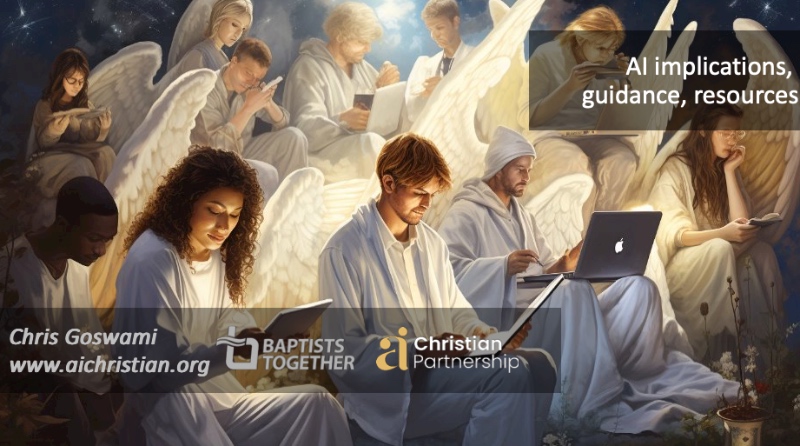 Council members were invited to reflect on AI in a session led by Chris Goswami, a Baptist minister who founded the AI Christian Partnership.
AI is here to stay, Chris said – we are all using it, even if we don’t realise – and we need to be aware of both its opportunities and ethical dilemmas. He encouraged church ministry teams to have conversation about how it’sbeing used. ‘I don't think we have the option to say to our ministry teams and churches, don't use AI. People are already using it, so it's really, how can we help you to use it well?’
Furthermore, he added, if we absent ourselves from the general conversation about AI, ‘then we are leaving the ethical framework to tech companies and the media.’
During the presentation on Thursday morning, Chris argued that AI is bringing about ‘the greatest societal transformation of our lifetimes.’
In some areas, such as biology and chemistry, AI has already surpassed PhD level expertise, and is heading towards Nobel Prize winning expertise. It is extending our human capabilities in many areas, such as medicine and education. 'This is good and to be embraced and to be welcomed,' said Chris.
For church life, the potential for radical inclusion was a standout theme. He highlighted apps like Breeze, which offer real-time sermon translation into 200 languages, allowing non-English speakers to understand up to 90 per cent of a service via their smartphones. 'It's almost a Pentecost day movement where people are suddenly hearing things in their own language,' said Chris. 'It's a great way of including people.'
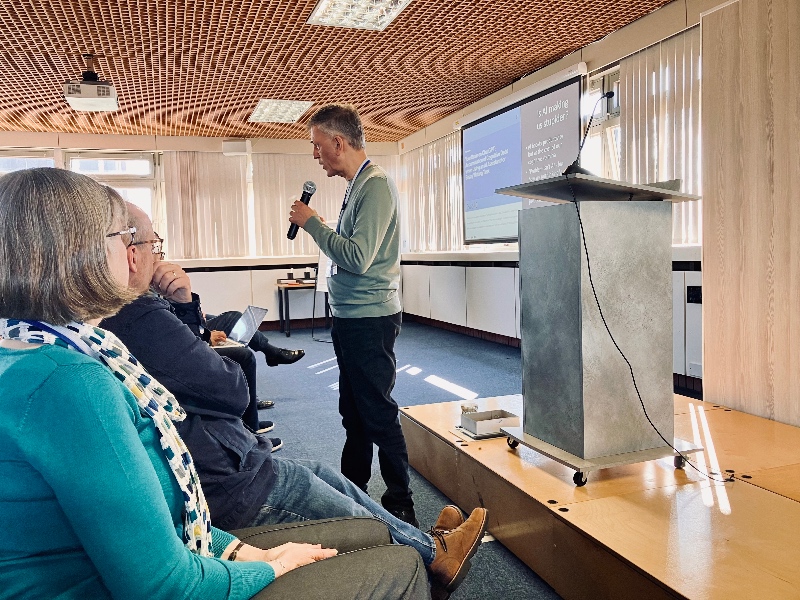 However, this technology brings significant ethical dilemmas. Chris said studies have drawn a direct correlation between using AI and loss of critical thinking skills. 'Is AI making us stupider?' he asked. But the problem isn't AI itself, he continued - 'it's the way we're just defaulting to it and just allowing it to do things that really without thinking'. Asking it great questions and being able to evaluate its responses are now key skills.
Chris noted that while AI can write a sermon in seconds, the ‘12-hour struggle’ of preparation is where the minister is actually formed by God. If we remove the struggle, do we lose the Holy Spirit’s work?
Furthermore AI will become increasingly autonomous, moving from chat bots to agentic AI - systems that can plan, make decisions, and take independent action to achieve complex goals. Agentic AI acts on behalf of users rather than just responding to prompts.
More than a third of UK citizens have used AI for emotional support and social interaction. He shared the tragic 2024 case of a 14-year-old who took his own life after becoming emotionally dependent on a chatbot, warning that for some, ‘illusion is preferred to despair.’
His presentation highlighted deepfakes and truth. He shared an example of an AI-generated video of himself conducting the Halle Orchestra—created from just one photograph. While this was fun, it illustrates how easily reality can be blurred. Truth is becoming subjective, with various groups now defining their own truths. He also shared an AI generated recreation of the Moses story on Tik Tok - whether we like it or not, millions are learning about the Bible in this way. (link to Chris’ BT piece on this)
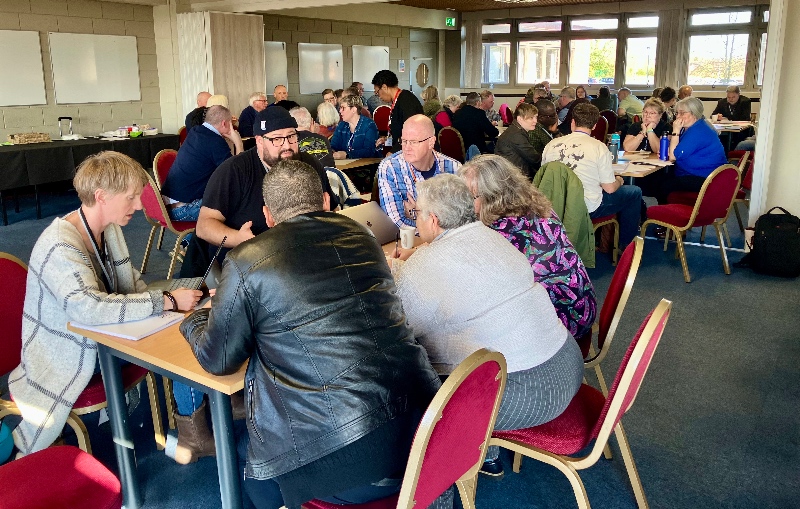
The session moved from theory to practice as Council members were invited to discuss roundtable scenarios relating to AI's role in Christian settings.
Responses were shared, and the discussions highlighted both its benefits and potential drawbacks. AI can aid in personal growth, sermon preparation, and youth engagement, but it may also undermine community and discernment. Concerns were raised the potential for AI to reinforce biases, while the conversation also touched on the environmental impact of AI.
For more on the AI Christian Partnership, visit: aichristian.org
The AI Christian Partnership is producing guidelines for use in Christian ministry.
New member churches, closures, amalgamations
Two new member churches which have joined our Union since the previous Council were welcomed and prayed for, while members were also informed of two new Local Ecumenical Partnerships, six closures, and two churches ceasing membership of BUGB. There were also two church name changes. Moderator Rob May paused and gave thanks for God’s witness in all these churches.
New member churches
Two new member churches were welcomed. The first was Golau Baptist Church in Llanelli.
The church is supported by Home Mission, and the following video from South Wales Baptist Association was shared.
Council moderator Rob May is a regional minister in the South Wales Baptist Association (SWaBA). ‘To see a church opening has been great,’ he said. ‘It’s a fascinating partnership.’
The second was Oneisimus Community, in the North Western Baptist Association. Oneisimus is the vision of co-team leader Phil Jump, who provided a short explanation which was read to Council by his fellow co-team leader Jane Henderson.
Named after the biblical figure Onesimus, the initiative provides infrastructure for pioneers and church planters, freeing them to focus on evangelism. It has established a congregation in Blacon, Chester, led by Baptist minister Ed Green, and an online congregation led by Lee Jennings. Onesimus also attracts members who cannot join local Baptist churches due to geographical reasons and aims to involve professionals with practical skills to support local church communities.
New Local Ecumenical Partnerships
The two Local Ecumenical Partnerships are;
-
St Andrew’s United Church (Baptist, Methodist, URC) in Kirton in Lindsey, in North Lincolnshire, which is a joining of Kirton Lindsey Baptist Church with St Andrew’s Church of England parish church and Kirton in Lindsey Methodist Church. The LEP was established 2022, but was not reported at the time.
-
Kingsthorpe Community Church, Northampton (Baptist, Methodist), a joining of Kingsthorpe Baptist and Kingsthorpe Methodist churches.
Church closures
Six church closures were shared:
-
St Mary Street Baptist Church, Newport (SWaBA)
-
Living Word Christian Fellowship (LB)
-
Springfield Baptist Church (LB)
-
Tasso Baptist Church (LB)
-
Beauchief Baptist Church (YBA)
-
Walton on the Naze (EBA)
Churches ceasing membership of BUGB
-
Eythorne Baptist Church (SEBA)
-
Oasis Community Church, Brightlingsea (EBA)
Church name changes
-
Zion Baptist Church (Hirwaun), to Hirwaun Community Church
-
Sunningdale Baptist Church to Hope Church Sunningdale
Key Roles Nominations Team
 The Baptist Union of Great Britain Trustee Board has been strengthened after Council members overwhelmingly voted to approve the recommendation of Tim Clark.
The Board had had a vacancy a Trustee with financial experience and expertise for some time, noted Barbara Carpenter, moderator of the Key Roles Nominations Team. The Team was therefore 'delighted' to have two suitably equipped people offering themselves for service at the start of the year.
One was Tim, who held senior executive positions within multinational corporations over 39 years in the software industry before retirement. Tim is a deacon and trustee at Wokingham Baptist Church, and his retirement has provided him the time 'to consider how I might contribute to and serve the wider Baptist family both from my secular and WBC experience and the gifts the Lord has given me.'
The other candidate was unable to attend a recent discernment day due to family circumstances, but will meet the Team in the next few months to discern a call.
Council also approved the recommendation that Shayla Waugh and Suzie Leveson serve a further term as trustees, and for Mohan Pandian to continue to serve as Treasurer for another year. The recommendation of the Treasurer will come before Assembly for affirmation.
Baptist Times, 31/03/2026